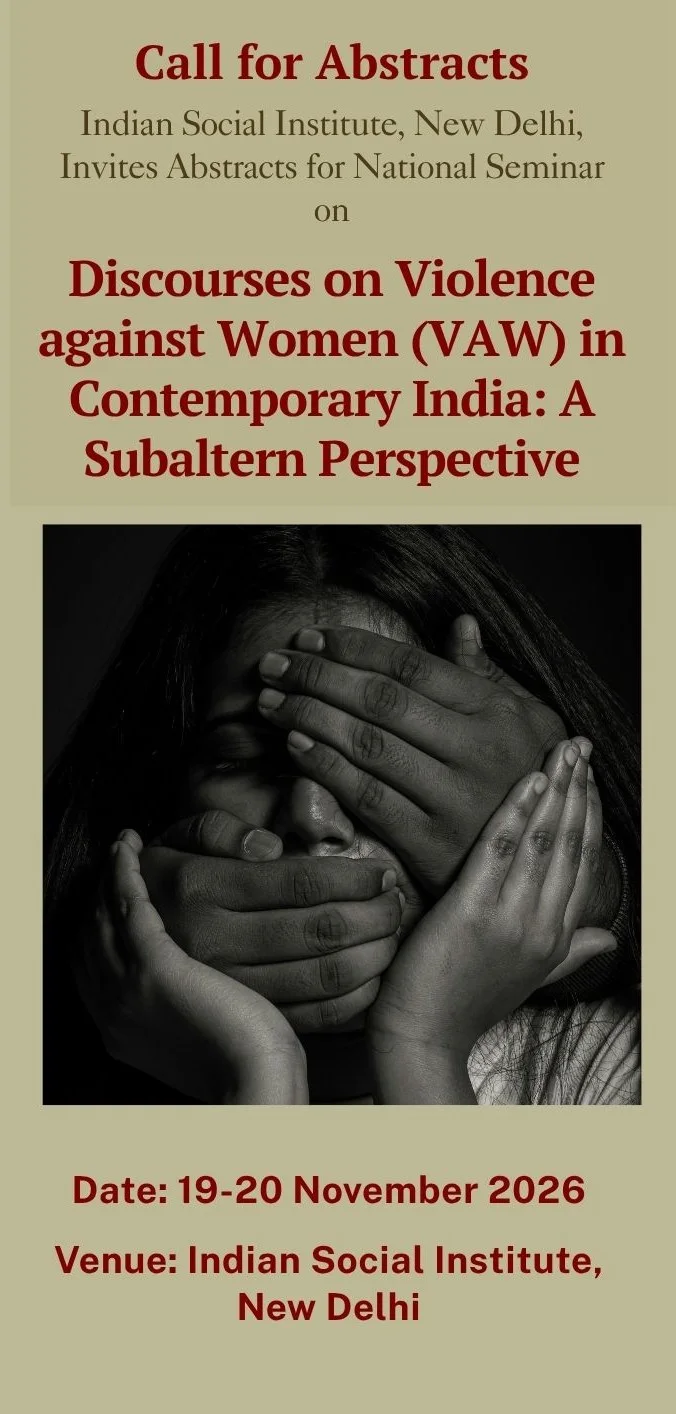
Date: 19-20 November 2026
Venue: Indian Social Institute, New Delhi
Concept Note
The World Health Organisation reports that every one in three women globally faces sexual or physical violence at least once in their lifetime. According to WHO’s definition violence can be understood as the “intentional use of physical force or power, threatened or actual, against oneself, another person, or against a group or community, that either results in, or has a high likelihood of, resulting in injury, death, psychological harm, maldevelopment or deprivation”.
The UN defines Violence Against Women (VAW) as “any act of gender-based violence resulting in physical, sexual, or mental harm, including threats, coercion, or deprivation of liberty, in public or private life”. Empowerment and the welfare of women have been central to feminist discourses across the globe. The deep-rooted violence, inequality, institutional hierarchy, systematic discrimination and injustice against women have been historically carried out throughout most forms of societies, cultures and civilisations. Cultural violence often deeply embedded in a patriarchal structure, significantly contributes to institutionally normalised violence against women.
Subaltern perspective provides the socio-historical experiences of Indian women, their responses, scholarships and contingency developed through Perspectives. Subaltern view expands the horizon of available literature and debates on violence against women, but it needs pluralistic revision to offer a rethinking. The subaltern perspective represents those voiceless accounts of violence against women without critiquing the dominant discourses on it from Western perspectives. Therefore, it will take new voices, literature and sensibilities, both pedagogical and personal.
VAW may take place in multiple forms, like physical, sexual, psychological, or economic abuse across private and public spheres. It includes several practices, such as child marriage, female genital mutilation, etc. The manner and nature of violence inflicted on women vary across societies. Women trapped in conflict areas may have higher risk of being more prone to violence, resulting in severe, long-lasting damage with implications for future generations. It has devastating implications for women’s physical and mental health and well-being.
Several policies and existing laws in India (like the Protection of Women from Domestic Violence Act, 2005; Indian Penal Code Section 376; the Sexual Harassment of Women at Workplace Act, 2013, and the Criminal Law Amendment Act, 2013) cater to the protection and safety of women. However, the safety of women continues to be a pertinent global challenge and concern, more so in the contemporary world, with the rise of cyber harassment and online stalking. It is one of the most widespread gender-based violations of human rights and well-being, causing serious concern across all societies and cultures. This seminar brings discourses on various issues, challenges and prospects for women in Contemporary India.
Objectives:
1. The purpose of the seminar is to have a deeper understanding of the concept, typology and manifestations of VAW.
2. To elaborate on the growing nature of VAW and its implications, and critically assess the institutional norms and value system in facilitating VAW.
3. To review the role of agencies, particularly state mechanisms, in dealing with women’s safety and security
4. To have a shared understanding of the nature of challenges to women’s wellbeing in India and explore ways to mitigate them.
5. To contribute to developing a shared social awareness on VAW.
6. To recommend ways to enhance prospects for women’s safety, welfare, well-being, and preventive measures against VAW.
Themes:
1. Debates and discourses on VAW: from the local to the global: This may include conceptual and theoretical understanding of the subject. The significant works by eminent feminist scholars can be used to understand their literary contributions.
2. Gender Roles and VAW: The normative understanding of socially constructed roles for men and women may often contribute to violence.
3. Society, Culture and Religion: Society, culture, religion and their value system play an important role in shaping and defining the identities of women, their status, positions, roles, and rights.
4. Socio-Economic Inequality and VAW: Several dimensions of socio-economic inequality contribute to abuse and violence against women.
5. Institutional hierarchy and Subaltern voices: Power, authority, subjugation and domination as concepts are important factors in understanding the institutional hierarchy that defines the role and identity of women in society. This theme focuses on the various institutions (for example, caste, class, ethnicity, etc.) that play a role in the direct or indirect facilitation of violence or prevention of violence against women, particularly from marginalised sections of society.
6. Impact of violence on health, healthcare and well-being of women: Violence can have a severe effect on the health (both mental and physical) and well-being of women. Proper healthcare services are essential to women’s health and well-being, especially for those faced with violence.
7. Intergenerational impact of violence: Violence has a long-lasting impact across all societies, with intergenerational implications.
8. Challenges of women’s representation: Representation of women across various socio-cultural, economic and political spectrums becomes crucial to VAW.
9. Role of media and Cyber spaces: The portrayal of women in different media platforms plays an important role in understanding violence against women.
10. Environmental challenges and VAW: Environmental contexts (for example, floods, droughts, cyclones, landslides, and displacement) may expose women to violence.
11. Conflict and Violence: Conflict and violence are very closely related. The theme focuses on various dimensions of conflicts and their implications for women.
12. Role of State, Civil Society and international agencies: Despite several initiatives by the Indian state (laws, acts, policies, schemes), by civil societies and international agencies (e.g. UN conventions), mitigation of VAW continues to be a major challenge.
Important Timeline
Last Date for Abstract Submission: 31 July 2026
Abstract Acceptance Notification: 14 August 2026
Registration for Presenters and Audiences: 20 August-15 September 2026
Last Date for full paper submission: 31 October 2026
Please Note:
• The submission of a full paper is mandatory for presentation at the seminar.
• There is No Registration Fee; however, registration is mandatory for presenters and participants. A partial travel allowance and accommodation will be provided to the outstation paper presenters. In case of co-authored papers, partial TA and accommodation will be provided only to the presenter (one person). All participants will be provided with food.
• The selected papers from the seminar will be published in an edited volume.

Guidelines for abstract/paper submission:
All abstracts to be sent through the registration link/QR code:
https://forms.gle/BS6GdyshkqRFmvVMA\
Abstract: Abstracts should be in Times Roman font 12 with 1.5 spacing, within 250 words. including title and keywords, name and affiliation.
Paper: Paper submission (in Word file) should follow Times Roman, font 12 with 1.5 spacing, word limit 4000-6000 words including title, abstract, tables and figures (if any) and references (APA Style).
For further queries, please contact
Mr. Pascal Tirkey
Contact: 011-49534152/142 Mobile: 8700473494
Indian Social Institute, New Delhi 110003
Email: isi.seminar2026vaw@gmail.com
Website: https://isidelhi.org.in/