About the Conference
This conference aims to understand the interlinkages between urbanisation, gender, labour migration, informality, social protection, and governance in the context of India’s rapid socio-economic transformation. As cities expand and draw large numbers of migrant workers, new inequalities and vulnerabilities are emerging, especially for women, informal workers, and other marginalised populations living and working in precarious urban spaces.
A core focus of the conference is on urbanisation, gender, and labour migration, with particular attention to how gender shapes migration experiences, access to urban livelihoods, housing, mobility, and essential services. The conference will highlight the lived realities of women informal workers, including construction workers, domestic workers, street vendors, waste pickers, and platform workers, who face multiple challenges related to unsafe working conditions, wage insecurity, lack of legal protection, housing shortages, and exclusion from social security systems.
The conference also foregrounds safety, security, and gender-based violence in urban and semi- urban contexts. It will explore the spatial and structural nature of violence, including harassment in public and workplaces, domestic violence, and institutional neglect, and how these shape women’s mobility, labour participation, and overall well-being. Another key dimension is reproductive health and occupational health hazards, particularly among migrant and informal- sector women workers exposed to unsafe living and working conditions. We will critically examine barriers to accessing reproductive and maternal healthcare, occupational safety, and long-term health support mechanisms. Further, women face multiple forms of vulnerabilities and marginalisation in slums and resettlement colonies. We will focus on their well-being, safety, and access to social protection. It will explore issues of insecure tenure, lack of basic services, environmental risks, and exclusion from welfare programs, and how these intersect with gender, caste, class, and migration status.
The conference also critically engages with government policies and programmes, assessing their design, implementation, and impact on urban poor and migrant women. In parallel, it highlights the crucial role of civil society organisations and community-based initiatives in addressing service-delivery gaps, advocating for rights, and building collective capacity. The conference aims to promote evidence-based dialogue and develop contextually grounded strategies to advance gender-just, inclusive, and sustainable urban development.
Themes
Urbanisation, gender, and labour migration
Women informal workers and their challenges
Safety and security issues and gender-based violence
Reproductive health issues and occupational health hazards
Marginalised women – well-being, safety and social protection
Women’s vulnerabilities in slums and resettlement colonies
Government policies and performance
The role of civil society and community
Registration Details
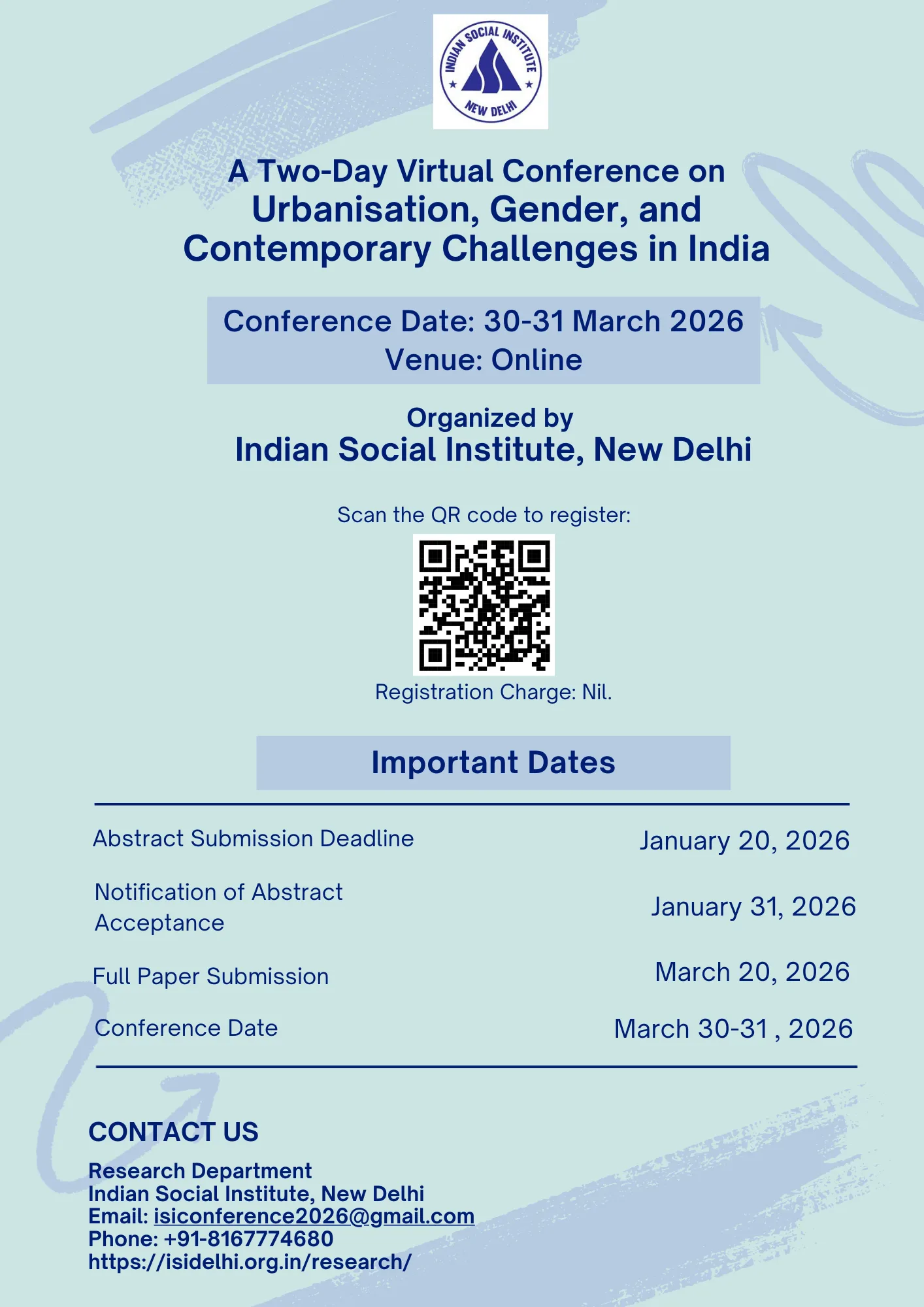
To register, fill out the Google form: https://forms.gle/2ECQm4EvpPVxntnh7
Registration Charge: Nil.
Who can register?
Postgraduate students, PhD scholars, post-docs, faculty, early-career researchers, NGO professionals, or any other individuals interested in urban issues and gender.
Submission Guidelines
Abstract Submission: The abstract must include the paper title, authors’ details (names, affiliations, email address, and contact number), and keywords. It should explicitly include background, methods, results, and conclusion. The abstract should not exceed 300 words. The abstract should be submitted online through Google form: https://forms.gle/2ECQm4EvpPVxntnh7
Full Paper Submission: The full paper should be original and unpublished work. The paper must be typed in Times New Roman, 12-point font, with 1.5 spacing and 1-inch margins on all sides. The length should not exceed 6,000 words (excluding tables, figures, and references). References should follow the Chicago style. Each paper should include a title page with the paper title, authors’ details (names, affiliations, email address, and contact number), and an abstract of up to 300 words. The full paper must be submitted to isiconference2026@gmail.com in Word format. The selected papers are planned to be published as an edited book with Routledge.
Important Dates
Abstract Submission Deadline: January 20, 2026
Notification of Abstract Acceptance: January 31, 2026
Full Paper Submission: March 20, 2026
Conference Date: 30 - 31 March 2026
About the Institution
The Indian Social Institute (ISI) was established as a research centre dedicated to fostering social transformation and advancing inclusive growth and development across all sections of society. The research department of ISI is working on critical themes, including poverty, livelihood, education, health, migration, peace and conflict, caste, gender, urbanisation, and development, with a particular focus on Dalits, tribals, and other vulnerable, disadvantaged, and marginalised communities. Guided by its vision and mission, ISI seeks to illuminate the lived realities of these groups and amplify their voices, thereby empowering them. Over the years, empirical research has been a key strength of ISI, shaping advocacy efforts and informing policy debates. The Institute continues to undertake diverse research projects, generate knowledge, publish findings, and organise seminars, workshops, and training programmes, all of which remain deeply rooted in its foundational commitment to engage with evolving socio-political contexts.
Contact us
Research Department
Indian Social Institute
10, Institutional Area, Lodhi Road
New Delhi- 110030
Email: isiconference2026@gmail.com
Phone: +91-8167774680